Pete Bowers claims that the <l> in <walk> and <yolk> has "no job in pronunciation."
That is totally false.
Pete also claims that <folk> is related to <fellow>.
That is also totally false.
Here is the back of the <l> card in the LEX Grapheme Deck, which explains (as it has done since 2011) how a post-vocalic <l> can work in words:
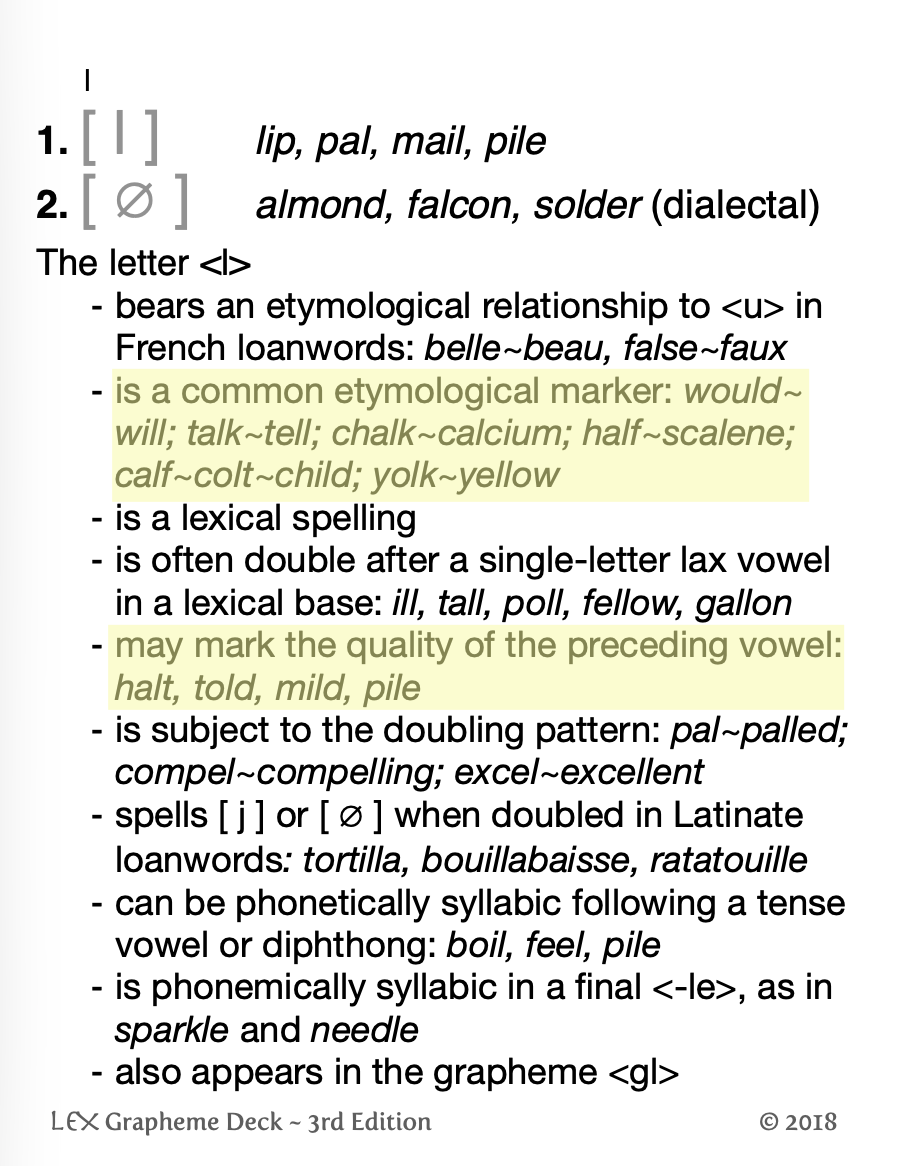
So, I'm not going to spell it all out for you. You can see right there that the reason for an "unpronounced" <l> in a word is likely etymological, and also that an "unpronounced" <l> can change the way a vowel is pronounced before it.
The proper linguistic term for "unpronounced" in reference to a grapheme or phoneme is zero or zeroed. Graphemes may be zeroed synchronically (as in sign~signal) or diachronically (as in two~twin). I've taught about this for a decade in my classes on phonemes and graphemes, including
The Nature of the Phoneme LEXinar
The Nature of the Grapheme LEXinar
The Science of Silence LEXinar
The Zero Allophone LEXinar
For a long time, the SWI world insisted that if a letter or letters didn't spell a phoneme in a word, then they couldn't be graphemes, but a grapheme is a minimal unit of orthography, not just a sound-spelling device.
Graphemes can do a lot of things besides spelling phonemes! In English, they can mark etymology. They can mark stress. They can mark function and content words. They can spell entire syllables, and they can spell entire morphemes. And in other languages, they have other cool functions. In the Romanized Popular Alphabet (RPA) writing system for Hmong, certain letters are used to mark its seven or eight distinct tones. The yumuşak ge or soft <g> in Turkish lengthens or diphthongizes the preceding vowel. In French, a silent <ent> marks a third person plural present tense verb.
Pete's new publication jumps through some hoops, and he confesses to having a hard time seeing the connection between "walk" and "wallow." It's all there in the etymology part of any proper dictionary. When my son was little, and I was homeschooling, I taught him about the <l> in walk by connecting it to its cousin waltz. I had him put his feet on mine, and we waltzed around the living room to "The Blue Danube." And before you tell me that second graders don't know what a waltz is, well, they don't know what wallowing is either.
It can be tempting to want to see a pattern, or perhaps to force one, when it's not as clear as you'd like. So if you see yolk~yellow and walk~wallow, you might stay stuck there, and you might not see walk~waltz, or you might claim *folk~fellow, but you'd be wrong about that. Like Pete.
The word folk is related to fill and full, and to the polloi in hoi polloi, which I remember distinctly learning from a middle school vocabulary list. Those have all the <l>s you need. The word fellow is historically a compound; the <l> was the initial consonant in the second base element.
I'm keyed up about this because phonics makes a zillion false claims about silent letters and etymologies. I've called out Louisa Moats's lies about this stuff for decades. To wit: boutique and ballet are not Norman French words. The Normans were Vikings. They did not have boutiques nor ballets. Those words are both modern French loan words, not medieval Anglo-Norman borrowings.
So the Structured Word Inquiry world does not needs its leaders repeating the same bone-headed, phonicky omission of actually looking up words in a darn dictionary before making false claims about their etymology in public spaces, let alone teaching those false claims directly to a classroom full of 2nd graders and their grateful teacher, who also didn't look up the words in the dictionary. I don't fault her; she's relying on Pete's expertise. And that's why he has to be the one to make sure what he says is accurate.
That's the etymological part, or at least some of it.
Here's the phonological part:
An <l>, like an <r>, spells a phoneme that is a liquid. Here's the definition of a liquid in phonetics, from my Mactionary:
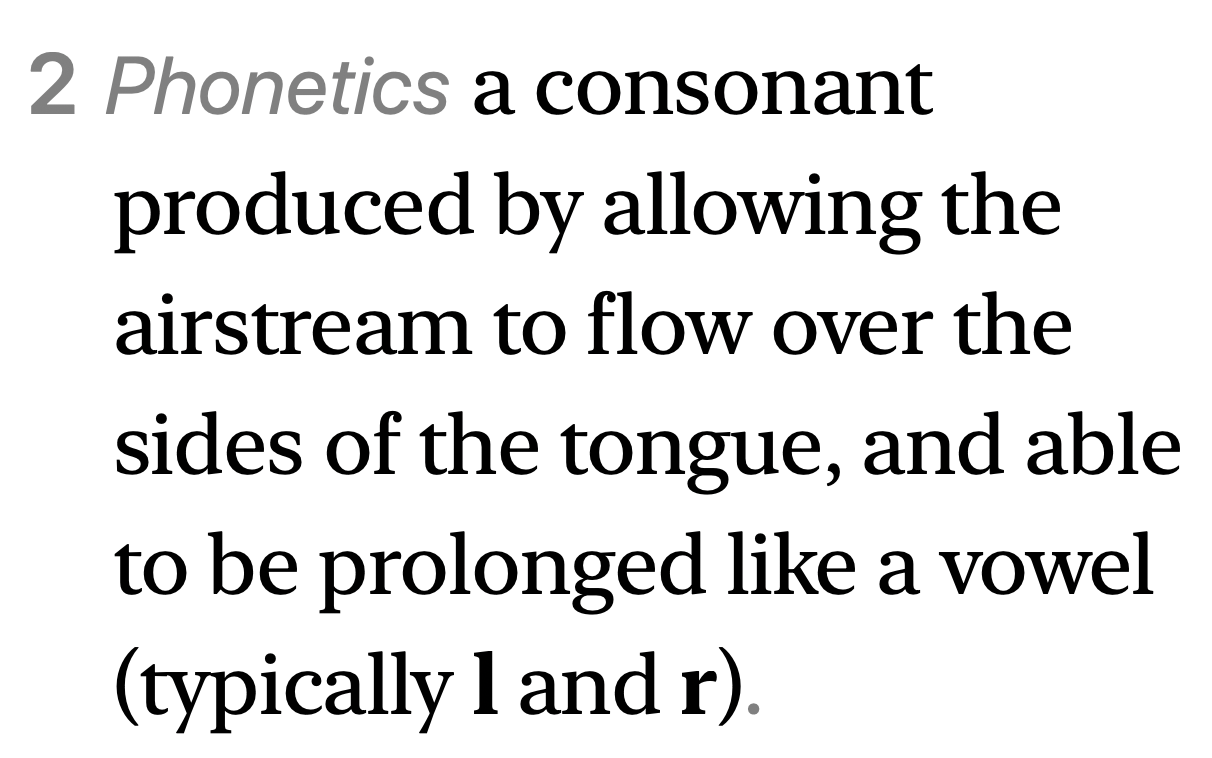
Not only can liquids be prolongued like a vowel; they can also be syllabic like vowels, and they can mark the quality of a vowel that preceds them. Phonics hammers this concept with what they call "<r>-control vowels," but that is often taught is really opaque and confusing ways. For example, phonics programs include <ear> in their inventories of so-called phonograms, but not <oar> or <our> or <eer> or <eir> or <ier> or a bunch of other vowel digraphs followed by <r>. And note: if you're going to include an <ear>, then you also have to include an <are> and an <ere>, and if you're gonna do that, then you may as well do all the vowels followed by <re>. This very quickly violates Occam's Razor, the Principle of Parsimony, by unnecessarily multiplying entities.
The LEX deck handles this by explaining what an <r> can do to a preceding vowel digraph instead of just blowing up the inventory.
Phonics is wholly lopsided here, because it never draws any connection between what it calls "<r>-control" and what it calls "closed syllable exceptions" or "kind old wild words." The simple linguistic fact is that liquids (and nasals) have the capacity to change or mark the pronunciation of the preceding vowel, yet no one calls words like talk, walk, folk, or mild "<l>-control" words. And Pete totally misses the boat when he claims that the <l> in walk and yolk and the like "ha[s] no job in pronunciation." It is not itself pronounced, but that's not what Pete said, and what Pete said is false. I'm working here, as I always have, to keep specious orthographic claims out of this study community.
I've written about silent letters for about 20 years. Here and here and here, and also here and here – that one is actually about silent <l> – and even here. I have two TED-Ed talks about silent letters, with more than a million views between them. Most of that work is available free of charge. I am also making this Shameless post available to the public, not behind a paywall, so folks can share it widely and talk about it to get the facts out there in front of the fabrications.
And then go ahead and subscribe. This post is free, but it's worth the small annual fee in and of itself.